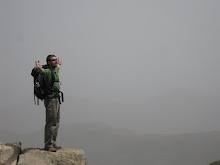
It's been a packed past couple of days. We had an extended weekend because of a heavier work schedule than normal over the past week. On Sunday a couple of us caught a longtail over to Ton Sai for hiking and hanging out at the beach for the day.
Monday was a whirlwind. We woke up early to go elephant trekking through the jungle, an experience punctuated by frequent stops for the elephant to absolutely demolish gargantuan trees and branches to choke them down for breakfast. Then we drove to Emerald Pool, where we hiked and swam in the national park and wildlife sanctuary, before chowing on Pad Thai. In the afternoon we idled lazily in the hot springs, a place where steaming hot water cascades down a series of bowl-shaped rock outcroppings, comfortably reminiscent of hot tubs, before tumbling into a refreshingly cool stream shaded by countless bamboo trees that formed an archway above.
Thoroughly relaxed by the hot springs, we then made a grueling 1,237-step climb to the top of Tiger Cave Temple, a Buddhist shrine perched precariously on a spindle of limestone that erupts nearly a thousand meters in the air, as if grasping for the heavens. The physical exertion in the scorching Thai heat drenched my shirt with sweat, and more than few times I peered through sweat-soaked eyes to see precipices dropping endlessly just inches from my feet, but the view at the top erased these thoughts from my mind. The Andaman coast and familiar limestone karsts stretched boundlessly before my eyes, providing a heavenly backdrop for the verdant greenery that abounded, interrupted only by the occasional rubber tree farm that dotted the landscape.
After snapping some pictures, I headed down and back for dinner and a shower. Unfortunately, our project coordinator's mom had died the night before, so on Monday night we attended her funeral. Although the southern Thai peninsula is dominated by Islam (a fact corroborated by the call to prayer at the crack of dawn every morning), her mother was Buddhist, which meant a funeral at one of the Buddhist temples in town. Through the acrid smell of burning incense (Buddhist tradition dictates that everyone present at the funeral lights a stick of incense and says a prayer before the casket), Buddhist monks garbed in orange robes chanted prayers, while attendees honored the dead by offering prayers over clasped hands. It was my first Buddhist funeral, and definitely a unique cultural experience that enriched my time here.
Tuesday our conservation team boarded the dive boat for a two day seahorse release project that had been in the works for quite some time, a result of our partnership with marine fisheries officials here in the region. Over the course of five dives, we released and monitored the seahorses as they adapted to their new environment. On Tuesday night, we made a night dive, the first night dive for most of us. Through the glow of a flashlight, I was able to observe some unique aquatic life, including rare crustaceans, a meter-long barracuda, and three sharks! At the bottom of the ocean, in the middle of the pitch black night, the object of interest for three sharks, I came to the comforting realization that this experience combined three of man's deepest fears: deep water, the dark, and sharks. And all in a night's work.
Between dives, I fished for fish and squid with the Thai crew, pulling in enough for a delicious lunch the following day. Anchored in the middle of the Andaman Sea, we observed the dazzling array of stars before sleeping on the boat, and then woke up to make two more dives, before returning to the mainland throroughly exhausted. Which brings me to the present, my eyes heavy with fatigue, hunched over a computer, composing this masterpiece for your eyes. So without further ramblings, I'm signing off until next time.
Wednesday, May 27, 2009
Wednesday, May 20, 2009
Only in Thailand...
Working with my gloves and sea snips I meticulously began removing the one gigantic net while remaining cognizant of the reef on which it was lodged. As I was stuffing the net in my salvage bag, I noticed a badly damaged Moorish Idol (a beautiful black, white, and yellow fish in the Bannerfish family, from which the Angelfish hails) swimming furiously in my bag. I quickly cut the fish free, and it swam away slowly and painfully, although it was visibly apparent that its efforts to break free from the fishing net over the previous few days had caused some significant damage to its body and fins.
Yesterday afternoon, a few volunteers and I climbed on motos for a 30-minute ride to a 7.4km trail that a local had recommended to us. After a fairly grueling ascent, made more strenuous by the sweltering afternoon heat, we emerged on a rocky face overlooking the better part of Krabi province. We estimated visibility at around 50km or so, and the view was spectacular, with a broad expanse of ocean and tropical islands cutting away to the west and Krabi's fabled limestone karsts dominating the east.
Also at the top, we encountered a group of six young Thai guys who had hiked up to camp for the night. As I approached their campsite, the first two things I saw were three rifles leaned up against an adjacent rock and a Thai man furiously swinging a cleaver at what appeared to have once been a chicken, blood flying everywhere. Typical of Thai people, these guys were almost disconcertingly (for an American, at least) friendly, and didn't hesitate to offer me some of the chicken and rice they were cooking over banana leaves. I helped them set up their tent and chatted with them for a while, before continuing on down the trail, inhaling the gorgeous views off of each side of the ridge.
Today we had the day off, and some friends and I took the 20-minute longtail ride to a small village called Railay (alternately spelled Rai Leh), rendered accesible only by boat as a result of behemoth limestone rock formations that immure the small huts and beautiful beach. We rock climbed all morning, and the climbing was excellent, although the view from the craggy top was even more spectacular. In the afternoon we headed back to Ao Nang where we took a Thai cooking lesson in which we prepared (and ultimately ate, of course) a seven-course Thai meal. And all in a day's work.
Tuesday, May 12, 2009
Sweaty Buses, Spicy Food, and Spectacular Landscapes

After a two-day flight, I arrived Saturday morning in Krabi, where I met our project coordinator and hopped on the bus. The drive from Krabi to Ao Nang, the small town in which I'll be living for the next month, was about 40 minutes. As we drew closer to Ao Nang, the scenery became more and more spectacular. Massive limestone karsts jutted out of the ground, smothered in all sorts of tropical vegetation, dwarfing trucks and scooters crawling along the two-lane road.
I showered and headed into town for a day of orientation, which essentially consisted of me eating obscene amounts of Phat Thai and checking in at the dive center, before returning via the bus. (Don't be misled by my terminology - the bus is no more than a pickup truck with two benches in the back.) Crammed in with about 12 Thais and sweating profusely in the mid-day sun, my thoughts punctuated by the intermittent barking of our driver as he recruited more people to pile in the back, a deef affection for Thailand began to settle in.
The next morning I awoke early for breakfast and a dive briefing, after which our conservation team boarded trucks for the three-minute drive to the beach. There longtail boats, the rusty motors of which bucked to and fro at the graceful hands of our captain, ferried us to our larger dive boat. On the two hour boat ride to Phi Phi Don, my German roommate Eike and I reviewed our diving basics, and soon we arrived at Losanah Bay. The landscape was utterly breathtaking - behemoth rock formations leapt vertically for hundreds of feet from the shimmering water. Lush vegetation crept skyward, diverting their course for the many mysterious caves that pockmarked the rock face. I could tell this was going to be a memorable month.
While the rest of the team did marine life counts and managed Crown of Thorns populations, Eike and I did the first half of our dive review, before taking a succulent lunch of yellow curry rice and chicken on the boat in transit to Koh Yung. After completing our dive review, we embarked on the two-hour ride back to the mainland, and spent the afternoon studying our advanced dive manuals.
Today Eike and I finished the first half of our Advanced Dive course, logging a deep dive at Koh Bida Nai and a naturalist dive at Maya Nui. We were fortunate enough to see some barracudas, a turtle, and some blacktip reef sharks, among other aquatic life. After one more day of training we will be ready to begin working with the team.
Wednesday, May 6, 2009
Land of Smiles, Here I Come

I am about to embark on a journey of a lifetime, a foray into the enigmatic region of Southeast Asia, a jaunt into the unexplored land of mystery and romance. As I sit here packing my backpack and making last minute preparations, it's hard to believe that tomorrow will set into motion a semester's worth of planning, and I'll soon be on my way to the aptly named Land of Smiles.
My plan is to spend the month of May working on a reef conservation project in Ao Nang, Thailand, and for the month of June I'm heading to Phnom Penh, Cambodia to teach a leadership class to university students. Then I'll spend most of July traveling through Vietnam and Laos, before heading back to the States on July 26. So tomorrow I'm hopping on a plane for the brutal Greensboro - Detroit - Tokyo - Bangkok - Krabi flight, due to put me in on Saturday morning.
Now for a little Thai history. Historians believe that the first Thai settlers ventured southwest from modern-day China and came under the rule of the legendary Angkor Empire. Sometime in the 13th and 14th centuries, a series of Thai kings were able to wrest control from the Angkor influence, and Thailand enjoyed 400 years and 34 reigns worth of peace. In 1765 the Burmese invaded and sacked the capital, which Thais later rebuilt as Bangkok, and after which the Chakri dynasty assumed power, beginning the line of kings still in power today. To ward off Western imperialism, kings in the Chakri line pursued progressive reform measures, and were later forced to forfeit significant land holdings in Laos and Cambodia. (It's worth adding that Thailand, meaning 'Land of the Free,' has never been colonized, with the exception of a brief Japanese occupation during WWII.)
A peaceful coup in 1932 marked the beginning of a constitutional monarchy and ushered in five decades of oppressive rule by anticommunist military dictators. Although one of Thailand's Prime Ministers attempted to shift the country to a representative democracy in the 1980s, the military ousted that government in 1991, giving rise to violent demonstrations and a shift back toward civilian rule. The nation implemented its sixteenth constitution (the first one ever penned without military oversight in Thai history) in 1997 which provided for significant democratic reforms. Thailand enjoyed tremendous economic growth throughout the early 1990s, but with the East Asian financial crisis in 1997, experienced a prolonged recession. The country has bounced back from the economic hardships of the 90s, largely due to the resilience of the Thai baht, and has weathered the current economic crisis relatively well.
Following what external observers called the cleanest elections in Thai history in 2001 and 2005, a military junta overthrew the government of Thaksin Shinawatra in 2006, and imposed martial law on the country. Democratic elections again made an appearance in 2007, and after dumping two corrupt leaders, Thailand settled in December 2008 (disconcertingly recent?) on current Prime Minister Abhisit Vejjajiva. Over the past few months, the exiled former PM Shinawatra has routinely stoked domestic discontent, prompting major riots and an official declaration of emergency in mid-April 2009. Although Vejjajiva has been somewhat effective in mitigating instability, the current political situation in Thailand can be summarized as tenuous at best. King Bhumibol Adulyadej has ruled since 1946, often exercising immense influence and intervening decisively in times of crisis, and continues to enjoy the protection of stringent lèse majesté laws.
Hopefully for my faithful readers, that will be the last time (at least for a while) that history major Matthew strikes, but I'm not making any promises. Thanks for reading, and I'll be sure and post when I arrive in Ao Nang, as soon as I have Internet and have recovered from jetlag.
My plan is to spend the month of May working on a reef conservation project in Ao Nang, Thailand, and for the month of June I'm heading to Phnom Penh, Cambodia to teach a leadership class to university students. Then I'll spend most of July traveling through Vietnam and Laos, before heading back to the States on July 26. So tomorrow I'm hopping on a plane for the brutal Greensboro - Detroit - Tokyo - Bangkok - Krabi flight, due to put me in on Saturday morning.
Now for a little Thai history. Historians believe that the first Thai settlers ventured southwest from modern-day China and came under the rule of the legendary Angkor Empire. Sometime in the 13th and 14th centuries, a series of Thai kings were able to wrest control from the Angkor influence, and Thailand enjoyed 400 years and 34 reigns worth of peace. In 1765 the Burmese invaded and sacked the capital, which Thais later rebuilt as Bangkok, and after which the Chakri dynasty assumed power, beginning the line of kings still in power today. To ward off Western imperialism, kings in the Chakri line pursued progressive reform measures, and were later forced to forfeit significant land holdings in Laos and Cambodia. (It's worth adding that Thailand, meaning 'Land of the Free,' has never been colonized, with the exception of a brief Japanese occupation during WWII.)
A peaceful coup in 1932 marked the beginning of a constitutional monarchy and ushered in five decades of oppressive rule by anticommunist military dictators. Although one of Thailand's Prime Ministers attempted to shift the country to a representative democracy in the 1980s, the military ousted that government in 1991, giving rise to violent demonstrations and a shift back toward civilian rule. The nation implemented its sixteenth constitution (the first one ever penned without military oversight in Thai history) in 1997 which provided for significant democratic reforms. Thailand enjoyed tremendous economic growth throughout the early 1990s, but with the East Asian financial crisis in 1997, experienced a prolonged recession. The country has bounced back from the economic hardships of the 90s, largely due to the resilience of the Thai baht, and has weathered the current economic crisis relatively well.
Following what external observers called the cleanest elections in Thai history in 2001 and 2005, a military junta overthrew the government of Thaksin Shinawatra in 2006, and imposed martial law on the country. Democratic elections again made an appearance in 2007, and after dumping two corrupt leaders, Thailand settled in December 2008 (disconcertingly recent?) on current Prime Minister Abhisit Vejjajiva. Over the past few months, the exiled former PM Shinawatra has routinely stoked domestic discontent, prompting major riots and an official declaration of emergency in mid-April 2009. Although Vejjajiva has been somewhat effective in mitigating instability, the current political situation in Thailand can be summarized as tenuous at best. King Bhumibol Adulyadej has ruled since 1946, often exercising immense influence and intervening decisively in times of crisis, and continues to enjoy the protection of stringent lèse majesté laws.
Hopefully for my faithful readers, that will be the last time (at least for a while) that history major Matthew strikes, but I'm not making any promises. Thanks for reading, and I'll be sure and post when I arrive in Ao Nang, as soon as I have Internet and have recovered from jetlag.
Subscribe to:
Posts (Atom)